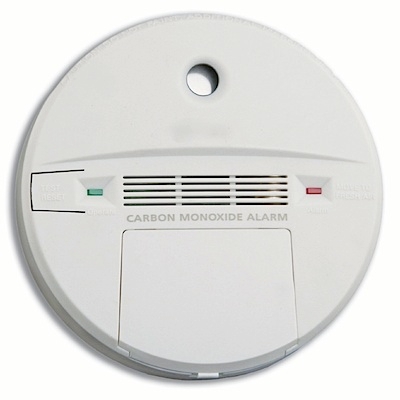
A CO alarm – check them regularly (note – this is not necessarily one of those tested).
The Trading Standards Service has issued a warning to tenants to check that their carbon monoxide (CO) alarm is in working order, after tests showed that many of the devices were faulty. By James Hunt:
The Trading Standards Service has issued a warning to consumers after independent tests on CO alarms found that eight out of 10 failed British Standards tests in one way or another. It is reported that all but one of the CO alarms tested went off eventually, but the standard requires much better than this level of performance.
CO alarms are sold to alert consumers to rising and deadly CO levels – nicknamed the ‘silent killer’ – yet the tests also showed problems relating to the alarms’ internal sensors having a ‘limited and indeterminable life’. Indeed, earlier research had shown that that up to 45% of CO alarms less than a few years old are no longer sensing gas.
New legislation for landlords
The Trading Standards warning comes as new smoke and carbon monoxide legislation comes in to force demanding that all private sector landlords regularly test smoke and CO alarms in all rented properties.
The new requirements include smoke alarms to be fitted on every floor of every rented property – whether the property has a new or existing tenancy. In addition, this is now a requirement for alarms to be tested for new tenancies. This requirement does not extend to existing tenancies, but does not detract from the requirement to provide smoke alarms in all rental homes.
The new legislation, the Smoke and Carbon Monoxide Alarm (England) Regulations 2015, has now come into force (from 1st October 2015, and is expected to prevent up to 26 deaths and 670 injuries a year.
Test regularly
Trading Standards is advising consumers to check that their appliances are in proper working order and to regularly test their CO alarms in order to alert them to the ‘silent and invisible killer’.
Commented John Stones, MD of Gas Safe Europe: “Carbon monoxide is a silent killer and yet one that is easy to protect against. Consumers should fit alarms and regularly test them to ensure they’re in working order and fit for purpose.”
He continued: “To effectively test CO alarms and ensure that landlords meet the new legislation by having working alarms, they need to test the sensor and not rely on the so called Test Button which just tests the battery, buzzer and electronic circuit.
“This can only be done by injecting a specific and safe level of test gas over the alarm,” John Stones concluded.