Martyn Walley, National Technical Manager at Aico Ltd, explains the differences between domestic fire alarm types and why it’s essential you know the basic differences and can advise your customers on selecting the right alarm for the right location.
With more than 25 years in the business, Aico’s number one topic of enquiry to our technical team remains false alarms, almost always caused by an inappropriate alarm type being used. But selecting the right alarm is really not that difficult.
Just as you have different types of fire extinguishers to put out fires, you have a variety of alarm sensors to detect them. That’s because materials burn in different ways and produce different types of smoke.
In a residential property, smoke is normally one of two types: large particle smoke from smouldering fires typical of those involving furniture and electrical goods, and almost invisible smoke produced by fast flaming fires, most often caused by clothing or papers.
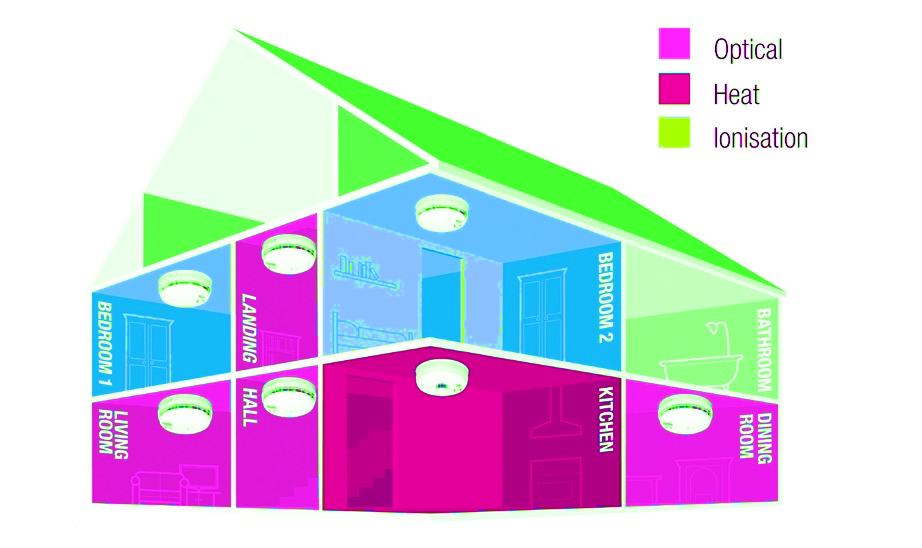
No matter who the manufacturer is, smoke alarms will be fitted with one of two different sensors – Optical or Ionisation. All but the most avant-garde homes will have similar, recognisable room content, i.e. a bed in a bedroom; cooker in a kitchen, etc. As a result it’s normally pretty easy to identify the types of fire that will occur in each room and therefore the type of sensor required.
Visible detection
Optical alarms operate on a visible detection basis. They feature a chamber that takes in the external atmosphere. A light beam is pulsed every few seconds to ‘look’ for smoke. When large particle smoke is detected, the light beam will be scattered onto the light receptor, which causes the alarm to sound. They are ideal for detecting smouldering fires and are also less likely to react to the type of invisible smoke produced by cooking fumes. This makes them suitable for circulation spaces such as hallways close to kitchens and landings. However, they can react to steam, so should not be located too close to bathrooms.
Ionisation alarms also feature a sensor chamber, but with a minute radioactive element (which is completely safe) that ionises the air within the chamber. This causes a small current to flow in the chamber unless smoke particles enter. When that occurs, the balance of the current is disturbed and this causes the alarm to sound. Ionisation alarms are sensitive to cooking fumes, so shouldn’t be used anywhere near a kitchen. Despite being the most popular alarm – most likely because they are the lowest cost – they are generally best left to bedrooms.
Heat alarms
A further alarm type is available – heat alarms. These don’t detect smoke at all, but react to temperatures of 58ºC or over. A heat alarm should only be used in a kitchen or garage, and only as part of a fire alarm system that also includes interconnected smoke alarms.
Alarm installation is guided by Building Regulations and BS 5839-6:2013 (the standard for domestic smoke alarm installations), which clearly identifies both grades of alarm system to use and categories of protection.
Grades are the type of alarm system to be fitted. Grade D is the most common for domestic properties, although larger properties may require a different grade of alarm system. Grade D requires one or more interlinked mains-powered smoke alarms (and heat alarms if required), each with an integral stand-by supply. The back-up supply can be from a rechargeable Lithium battery or alkaline battery.
Interlinking the alarms is essential as it provides an earlier warning for residents and the best chance of escape. When one alarm goes off, all the other alarms on the system activate – and there’s little chance of the occupant sleeping through that noise!
Hardwiring or wireless
Interlinking can be achieved through hardwiring or by using wireless interconnection technology, such as Aico’s RadioLINK, which is increasingly popular. Hard-wired interconnection is time consuming, disruptive and costly in existing properties, whereas wireless interconnection is quick, easy and requires no redecorating – customers (and end users) will thank you for recommending wireless systems, plus this is a great chance to upsell.
Grade F systems using battery powered alarms only are still permissible in certain existing properties, but we would advise against these because of the issues caused by residents not replacing the batteries.
Categories are the level of protection afforded by the smoke alarm system. This will generally be dependent on a risk assessment of the property and its occupants, with smokers and the infirm, for example, requiring a higher level of protection. The categories range from High (Category LD1) through to Minimum (Category LD3) protection. For those unsure, Aico recommends Medium protection (Category LD2) for the majority of installations. The level of protection required will dictate the number of rooms to be protected with an alarm, as laid out in BS 5839-6:2013.
Which alarm type?
If the type of alarm to be used is not clear (e.g. where the bathroom is close to the kitchen or where there is an open plan kitchen), then there’s the Multi-Sensor to the rescue; again, an excellent opportunity to upsell as these are pricier than a single sensor alarm but then you get double the sensors, plus in-built intelligence.
A Multi-Sensor combines optical and heat sensors in the one alarm unit and has built-in intelligence, which enables it to not only monitor the signals from both sensors, but also to interpret them. This allows it to detect all different fire types, from fast flaming through to slow smouldering, and provide the best possible protection to residents.
A guiding light
For alarm system specifiers and contractors involved in large scale smoke alarm installations, understanding these rules is absolutely essential. However, many installers don’t have the in-depth knowledge or maybe aren’t aware of some of the latest developments in the marketplace (such as the Multi-Sensor and wireless alarm interconnection). In these cases you have a role to play to ensure they get the right alarm types. It’s fundamental to a successful smoke alarm installation.
And if you or your customers are looking for more detailed information there are plenty of additional resources out there to help with the alarm selection process, including books, apps and web sites. Aico has a wide range of these including our Electrical Contractors Handybook, our online Smoke Alarm Specification Selector at www.aico.co.uk and a short YouTube animation (www.youtube.com/user/aicoalarms) to help further explain what alarms to fit where.