
Wireless sensor technology has many benefits in both new build and retrofit applications, as Sandy Damm, Managing Director of Sontay, explains.
We have fully adopted wireless technology in our homes; we can turn the kettle on without leaving the comfort of our sofas and even turn on the heating before we leave the office at night. However, we have only just started to embrace the power of wireless in commercial buildings. Contractors are keen to learn more about the latest innovations including wireless technology and electrical wholesalers are perfectly placed to educate their customers on the benefits of wireless.
Ease of installation
One of the key considerations when installing a control system is how long it will take, the disruption it could cause and the cost. By eliminating the need for structural cabling during sensor installation, wireless devices can greatly reduce engineering time and installed project cost. This enables faster and easier installation on new buildings and also opens up the opportunity for control specialists to retrofit energy efficient HVAC controls into existing commercial and public buildings.
In projects that feature our SonNet family of wireless sensors, we are typically finding total installed cost savings of 30% and more over comparable wired sensor installations. At a time, when reducing costs are a priority on many projects, proven wireless technology can bring significant benefit.
Reliability
Reliability is an important factor for specifiers and installers when they are considering a wireless system. No one wants a system that drops in and out and cannot be relied upon to give accurate and continual measures. SonNet comprises battery-powered sensor together with permanently powered network receivers and routers all built on a robust 2.4 GHz, 802.15.4 self-healing, wireless tree topology.
This topology is significant because it eliminates concerns with reception and reliability often associated with existing ‘point-to-point’ wireless systems. If a sensor detects a problem with the signal, it will automatically re-route to find the strongest available path to the receiver. Interference with other radio devices in the same frequency spectrum also been addressed through a proprietary algorithm which continually adapts to site conditions.
Something smart
Increased device-to-device communication is an important role within modern building management systems. Convergence is the hot topic at the moment and we are seeing a high number of devices and control systems using the internet protocol alongside traditional protocols for communication, such as BACnet and Modbus. Wireless variations of intelligent control devices are becoming much more readily available. This makes it easier to build, extend and increase the range and capabilities of a unified, integrated system.
Having said that, it is not just about devices working together; the ‘Internet of Things’ is also about the data that can be accessed. Here, sensors play the vital role. They are inherently smart, measuring, analysing and evaluating all sorts of building performance data and making this information available to the control system. By pulling together this information and using it to determine the actions of connected devices, we can create a truly ‘smart’ system. Cloud-based applications are key to using this data. The ‘Internet of Things’ does not function without the right collection and analytical tools to interpret and use the information intelligently.
Wireless technology is also making headway in the development of intelligent sensor products. For example, Sontay’s RF-IOM-4A-4U input/output module works in conjunction with SonNet sensors and routers and acts as a local I/O with connectivity to typical HVAC equipment, such as fan coil units or variable air volume boxes.
The module can take any 0-10Vdc, 4-20mA, resistive or VFC signal from wired devices in the field and transmit them to one of SonNet RF-RX receivers which in turn communicate the information to controller. The strategy within the controller uses this information to calculate control values, which are then passed back through the I/O module to alter damper positions and other output connections in the field.
When SonNet was first launched seven years ago, receivers collected data from the network and communicated them in 0-10Vdc output to the controller. Over time a receiver compatible with a JACE controller through a Niagara framework was developed and shortly after a gateway called SIP was launched making SonNet network compatible with Trend systems. This year, Sontay launched the new RF-RX-B SonNet receiver, which allows easy integration to BACnet controllers.
The new generation of ‘smart’ buildings can also benefit from wireless technology as it can be easily connected to internet based communication protocols. For instance, Sontay’s new RF-RX-B Network Radio receiver automatically maps data from SonNet devices into BACnet objects, which are transmitted via BACnet IP communication protocol, using a simple web browser interface. As a result, with this new network receiver, a SonNet network can now easily be integrated a BMS via BACnet IP.
All in one
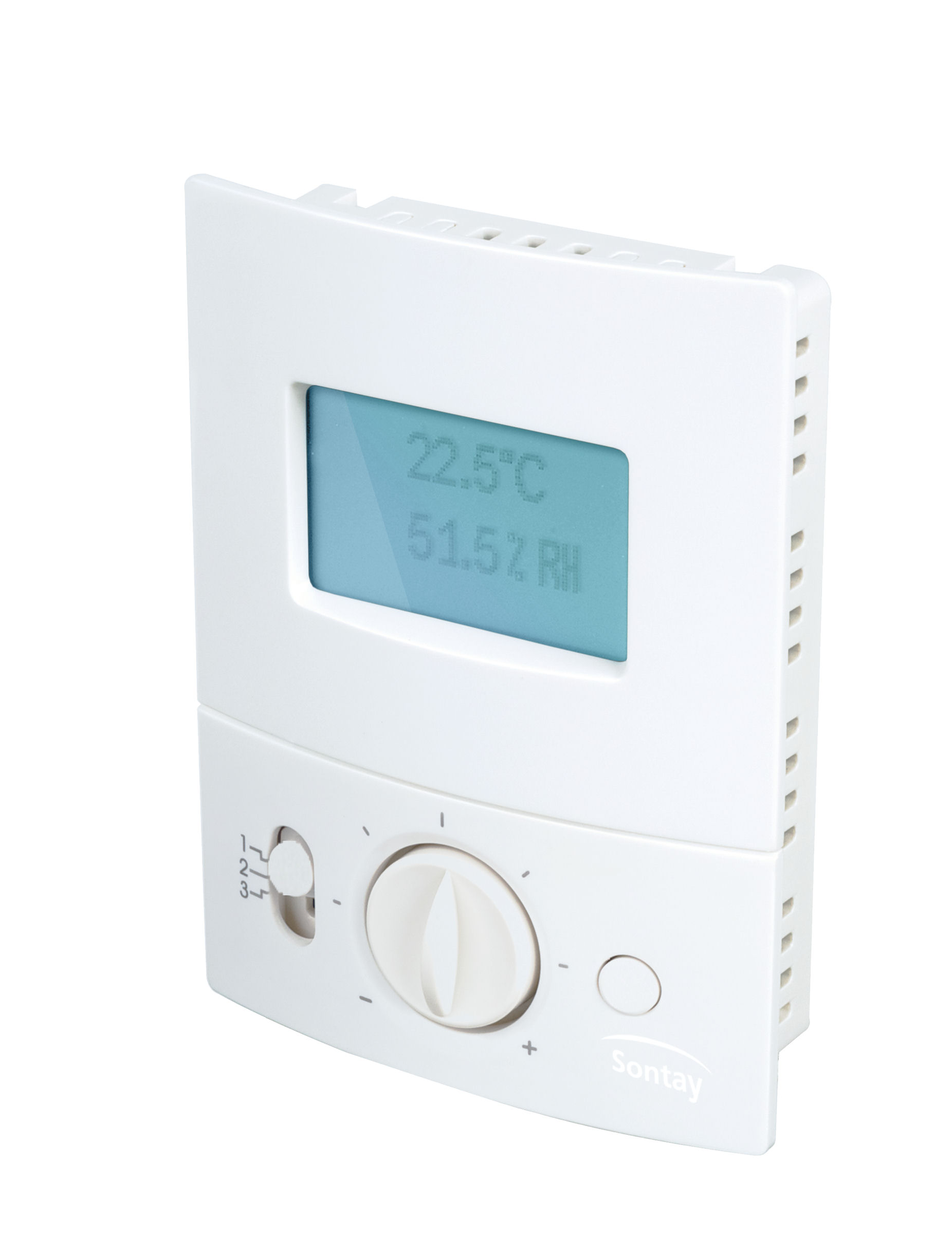
Sensors can also now range from a simple thermistor based room temperature device to a sophisticated smart protocol communication sensor. The latest multi-sensing products offer an increased level of functionality, tailored to suit any application. They provide complete environmental sensing within a single unit, with a whole range of variables being measured including temperature, CO2, relative humidity, light level, air quality and fan speed.
Popularity is growing for these multi-sensing devices as they are quicker, simpler and more cost effective to install and utilise just one cable to send all data, no matter how many variables are detected.
With wireless technology, many of the barriers to installing an intelligent Building Management System (BMS) have been removed. It is easy to install, reliable and cost effective and if electrical wholesalers can get this message across to their customers there is a huge business opportunity. Now is the time to embrace wireless technology and make all of our buildings smarter.
Below: Today’s multi-sensing devices offer an increased level of functionality, tailored to suit any application.