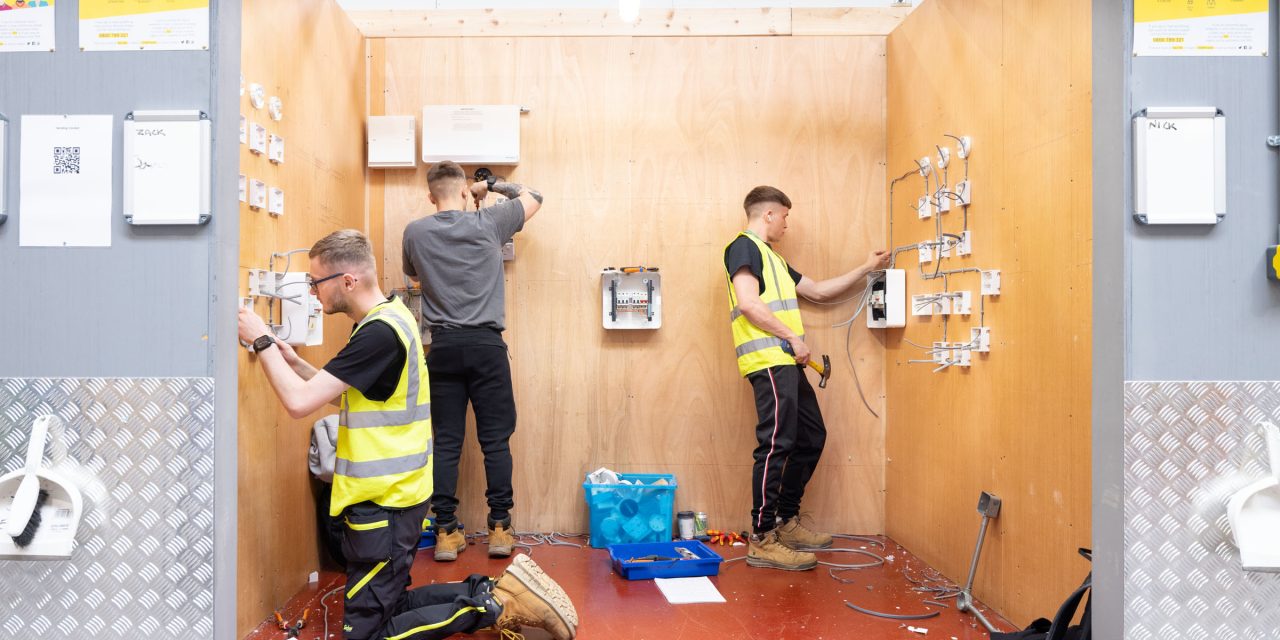
England faces a significant lack of people training to be electricians meaning key projects across energy and housing are at risk, according to new analysis from JTL. The government’s own assessment for electricians in construction and clean energy sectors alone requires the workforce to be 32,400 larger by 2035. With tens of billions of pounds of data centre projects expected this decade alongside major housing and energy infrastructure programmes, demand for skilled electricians is expected to rise significantly. Yet apprenticeship starts have fallen below 7,000 a year, well short of the 12,500 annual starts JTL estimates are needed to meet future demand.
JTL is warning that without stronger employer incentives, simpler apprenticeship processes and better alignment of public funding with routes that lead directly into skilled employment, the sector risks falling further behind demand. The training provider is calling on Government to introduce targeted incentives to help employers, particularly SMEs, take on and retain more apprentices.
Building on the electrical workforce projection model JTL pioneered in 2025, Powering the Future, which warned that England’s electrical workforce had dropped by over 26% since 2018 and that without further action it could decline a further 32% by 2038, this
data shows that England’s electrical workforce has remained effectively static, increasing only from 160,200 to 161,300 throughout 2025. Workforce outflow is expected to continue to exceed inflow and this critical sector is below the training levels needed to support housing, clean energy, infrastructure and data centre projects.
Developed by JTL in collaboration with industry partners, the projection model provides long-term, data-led insight and foresight into workforce size, skills levels and sector resilience. One year on from its conception, the model now shows that recent increases in JIB cardholders and NVQ or Experienced Worker Assessment entrants have helped improve the ‘known skilled person density’, which denotes competence, however the workforce size has not materially changed and is not on a growth trajectory.
The analysis also highlights a persistent achievement gap of around seven percent between levy and non-levy employers across the whole apprenticeship system, linked to factors such as employment stability. The gap is wider in trade based apprenticeships such as building services engineering (10-20%) where the prevalence of SMEs is significantly higher.
JTL’s analysis shows that the sector would need in the region of 12,500 apprenticeship starts annually, alongside around 5,500 other new entrants and an additional 800 individuals qualifying through NVQ or Experienced Worker Assessment routes, to have enough skilled workers to meet demand.
The findings come as new project and planning status analysis points to a major pipeline of data centre development expected to move forward before 2030, with work valued in the tens of billions. Presented at a recent ECA and BESA-sponsored industry roundtable attended by senior civil servants, the analysis highlights the growing demand for skilled electricians and ventilation, heating and cooling engineers needed to deliver the UK’s digital and clean energy infrastructure.
Chris Claydon, Chief Executive of JTL, said:
“One year on from our original research, the message is clear: the electrical workforce is still standing still. A modest increase in the workforce estimate (less than 1%) is not enough to build the capacity needed to deliver the UK’s housing, infrastructure, clean energy and digital ambitions.
“From grid upgrades and low-carbon technologies to the rapid growth of data centres, demand for skilled electricians and building services engineers is only increasing, but the training pipeline is not keeping pace.
“Apprenticeships remain the gold standard route into a competent electrical workforce, but we need support for more starts, greater hiring incentives for SMEs and a simpler system that makes it easier for businesses to invest in apprenticeships with confidence.”