Jim Wallace of Seaward encourages a common sense approach to ensuring the safety of electrical equipment, as cutting corners can carry considerable risks.
There is considerable evidence that faulty electrical appliances in the workplace continue to pose a real threat to people. The HSE continues to report around 1,000 workplace electrical accidents and 25 deaths each year. Fires started by poor electrical installations and faulty appliances also cause many more deaths and injuries – and considerable disruption to business activities.
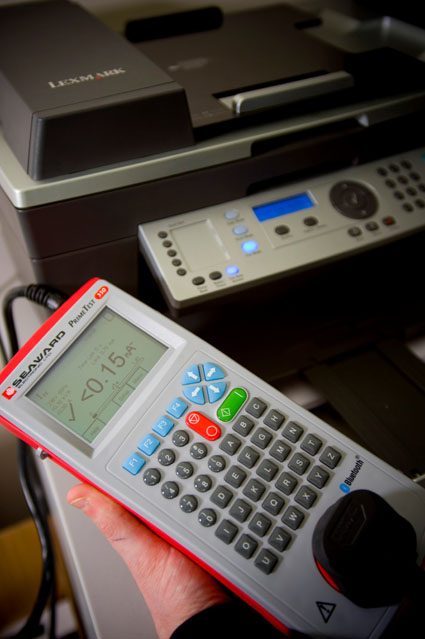
In response to this situation, there is indisputable evidence that the periodic inspection and testing of portable electrical equipment saves lives and prevents fires that may otherwise have caused injuries, loss of life and serious damage to business and work premises.
Nevertheless, in pursuit of maintaining cost efficiencies, electrical safety testing procedures are often among the first activities to be reviewed. However, those responsible should fully understand their obligations and the risks associated with any short circuiting of proper health and safety procedures.
Employers have a duty of care to ensure the electrical safety of all those using their premises under the Health and Safety At Work Act 1974.
As well as facing stiff penalties, those that ignore their responsibilities not only put their employees and customers at risk, but may also invalidate their commercial insurance policies and liability protection.
The requirements relating to the use and maintenance of electrical equipment in the workplace are contained in the Electricity at Work Regulations 1989 (EAWR). Regulation 4(2) of the EAWR requires all electrical systems to be maintained to prevent danger.
This requirement covers all items of electrical equipment including fixed, portable and transportable. Crucially, Regulation 29 adds that a suitable defence is proof that all reasonable steps and due diligence were exercised in avoiding unsafe conditions.
Originally, the IET’s Code of Practice for In-Service Inspection and Testing recommended that maintenance of electrical equipment is best carried out in four stages –
– visual inspection
– a test to verify earth continuity
– a test to verify insulation, and
– a functional test.
Although the essential tests for most electrical products are earth continuity and insulation resistance, the official advice has changed with the introduction of, for example, variations in applied voltages for insulation testing, changes to earth continuity test currents and new requirements in relation to checking cables, leads and RCD trip times.
In effect, different tests are now recommended as best practice depending on the type of equipment in use and associated risk factors.
As a result, those responsible for testing need to understand that not all PAT testers will be suitable for all appliances. A proper understanding of the type of tests (and therefore test instrument) to be carried out on different appliances is a fundamental competency requirement. Any failings or compromises in favour of low spec testers for all purpose PAT testing may therefore represent a significant safety risk.
For example, the best practice test requirements of surge protected devices or the presence of zero voltage switches will require some variations in the test specifications applied.
RCD testing
In the most modern PAT testers, RCD testing is now included in the suite of test options available to ensure that when an extension lead or multiway adaptor is fitted with an RCD, the operation of the RCD should be checked using an RCD test instrument to determine that the trip time is within specified limits.
In the same way, the IET Code also now recommends a choice of insulation test voltage of 250V DC or 500V DC – or the use of substitute or alternative leakage measurement for some types of electrical equipment. Again, not all testers are equipped with the capability to undertake this variety of tests.
All of these tests have an important safety role and can be crucial in ensuring that workplace safety programmes remain capable of detecting potential problems with electrical appliances before they occur.
Electrical portable appliances are often roughly handled when moved around, operate in a variety of environments and in many instances have more arduous and onerous usage compared to fixed equipment. As a result, at any time a significant proportion of electrical appliances used in workplaces could require re-testing to ensure that they do not pose a hazard to users.
The emphasis on maintaining a safe working environment is therefore constant and some examples of the sort of horror stories uncovered by periodic inspection and safety test programmes illustrate this point perfectly.
For example, one public sector employer insists that all faulty equipment must have the whole lead cut off as close to the appliance as possible. This is the result of an earlier situation when a caretaker rewired a plug onto an appliance that had previously had the plug removed after failing its regular test. The failed but reconnected appliance was then responsible for causing a fire causing thousands of pounds worth of damage.
In an engineering company, factory workers risked their lives by continually replacing a fuse that persistently failed in a power tool with a solid metal bar, rather than highlight the issue and question why the fuse was always blowing. The temporary modification was uncovered during a periodic portable appliance test.
Cable damage
Warehouse equipment left around floor areas can be particularly liable to cable damage from forklifts. In one case, a warehouse operative continued to use an electric drill with exposed wires rather than admit that it had been left out and damaged.
Even in offices, employees have been found to be taping up cracked power packs with tape rather than having them replaced. Elsewhere, in a school laboratory, a safety engineer had to take all the soldering irons out of service after the students had used them to burn through their own plugs.
All of these highly dangerous situations would not have been detected without the presence of effective visual inspection – including the proper inspection of plugs and fuses – alongside the correct electrical testing procedures with the appropriate test instrument.
Of course the need for establishing effective safety measures has to be balanced against practical aspects; realistic precautions for one organisation might be unacceptable for a larger or different type of business, but there is no substitute for carrying out the work properly whatever the situation.
In this respect, the risk assessment advice and emphasis on a common sense approach to safety testing intervals are provided by the HSE and the IET Code of Practice and are invaluable.
In particular, the clarification on the roles and responsibilities of dutyholders and contractors should have the effect of strengthening relationships and introducing higher standards of professionalism in the industry.
Unfortunately, an emphasis on cost reduction and cutting test corners runs the risk of undoing this progress. As a result, anyone engaged in cost efficiency introductions, leading to deliberate short cuts in the type of tests applied, needs to think very clearly about the potential consequences.
Where electrical safety is concerned, there is absolutely no room whatsoever for taking risks, ignoring visual warnings, eliminating tests or adopting dangerous practices.
www.seaward.co.uk