A recent NEPC report on infection resilient environments, which calls for a major upgrade of buildings to create healthier indoor environments, has been welcomed by leading ventilation manufacturer Vent-Axia.
The National Engineering Policy Centre (NEPC) report, ‘Infection Resilient Environments: Time for a Major Upgrade’, reveals that infection control measures could save up to £23 billion a year if there is another pandemic. It also recommends that the operational performance of buildings, including ventilation and infection resilience, should be regulated going forwards.
Commissioned in 2021 by the Government Chief Scientific Adviser, Sir Patrick Vallance, the new research, led by the Royal Academy of Engineering and the Chartered Institution of Building Services Engineers (CIBSE), set out to identify the measures needed to reduce transmission of infectious diseases in the UK’s built environment and transport systems. Ventilation has been found to be a key part of achieving this. In the foreword of the new report, Professor Chris Whitty, Chief Medical Officer for England, says: “The COVID-19 pandemic has shown again how people’s risk of being infected by respiratory infections is heavily influenced by their environment. Engineering interventions, such as effective ventilation indoors, can help to reduce transmission of many infections in places of work, study, at home, and on public transport.”
The report confirms that healthy buildings are good for infection resilience, but are also good for health, saving employers money due to less absences and better productivity. Vent-Axia welcomes the new report and agrees with its findings on ventilation improving infection resilience and improving productivity.
The report further states that improving ventilation, air quality and sanitation in buildings could minimise transmission, reducing the number of people infected, thereby saving lives and reducing ill health and its societal impacts.
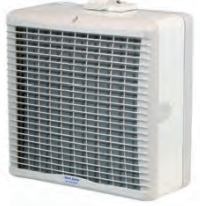
Vent-Axia is well prepared to help ensure buildings are healthy through effective ventilation hand-in-hand with CO2 monitors to check indoor air quality. For non-residential properties, Vent-Axia’s range of CO2 sensors can be discreetly located on a wall and can intelligently boost ventilation based on the detected CO2 levels. They can also provide a warning indication for occupants if CO2 levels rise above acceptable levels. Vent-Axia also offers a range of ventilation solutions including the Sentinel D-Box Fan range, which are suitable for continuous fresh air supply or extract of stale air or both. These fans can be connected to a CO2 sensor for optimal air quality control.
+44 (0)344 856 0590 www.vent-axia.com