 The solar PV market may no longer be the days of the Gold Rush for electrical contractors, but the technology’s ability to reduce energy bills and cut carbon emissions means there’s a still healthy commercial market. Andrew Brister reports.
Electrical contractors are always urged to consider new markets. For many, solar PV was the most profitable diversification of them all, as homeowners went crazy for a technology that was a licence to print money given the government incentives available in the early years of this decade. You could be forgiven for thinking that solar PV was dead and buried given the lack of interest nowadays. Not so. The domestic feeding frenzy has undoubtedly tailed off but there’s still a healthy market out there if you know where to look.
“Solar photovoltaics are still very viable commercially,” said Bill Wright, head of energy solutions at the ECA. “On sites where you’ve got a large, flat roof where you can use the power generated by the panels during the day, they are very effective.” Indeed, whereas the conversation around solar PV always used to focus on how much money could be made, as the incentives on offer by the government’s Feed-in Tariffs (FiTs) have dwindled, the argument for the technology is much more centred around how much energy can be saved, fuel bills cut and carbon emissions reduced.
The Government effectively made commercial schemes stand up without subsidies when it closed the Renewables Obligation from 1 April 2016 to all solar projects, both rooftop and ground mounted. The Renewables Obligation is the long-running scheme that supports larger-scale renewables projects, and will continue to be open to other technologies such as offshore wind, hydro and biomass until 2017. It was gradually being replaced with the Contracts for Difference auction system but currently no decision has been made on future auction rounds for ‘established’ technologies like solar.
The move was met with dismay by industry commentators. “Data shows relatively poor levels of deployment of solar on larger buildings like schools, factories and warehouses, where this technology is particularly efficient and cost-effective,” said Leonie Greene, head of external affairs at the Solar Trade Association. “We are very concerned that Government policy is now severely constraining growth across these prime rooftops. Worse, there is effectively no meaningful support now in the UK for solar schemes over 1MW in size. That cannot be right.”
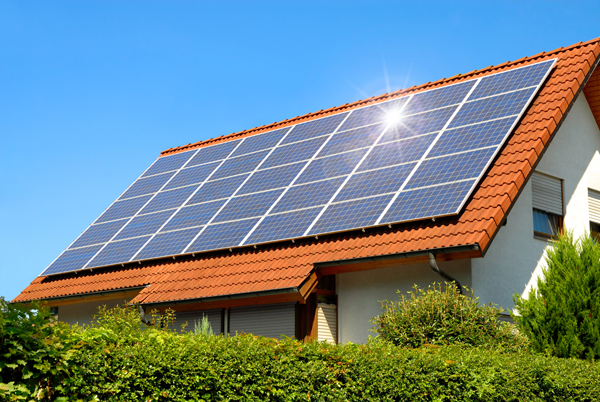
Latest deployment data shows that larger solar rooftops are only 10-15% of the market, much less than in other European countries, and represents an opportunity for electrical contractors. “We still get the odd domestic enquiry, but most of our work is on larger roofs now – schools, colleges, fire stations and the like,” commented Rafe Bateson, renewables director at W T Parker Group. “It’s energy-use dependent – the more you can use on-site, the better.”
Local authorities are keen to use the technology to drive down carbon emissions from their sites. “We are carrying out a number of larger rooftops for councils, for example on school extensions and sports halls,” confirmed Peter Gurr, technical manager at Wessex Energy. “It’s particularly attractive for high energy consumers, perhaps a sports centre with a swimming pool, where you’ve got a high daytime load. It can make a significant impact on energy costs and carbon emissions.”
Imtech has installed a massive solar scheme for the London Borough of Hounslow on the roof of Western International Market. The vast array of more than 6,000 solar panels on the rooftop of the wholesale market for fresh produce and flowers is said to be the largest such array put up by a local authority. Hounslow’s £2 million investment in solar is also the first by a council to adopt battery storage to maximise the power from the panels.
Battery power
The 1.73 MW array of 6,069 panels and four 60kW lithium batteries now generates half the site’s required electricity and Hounslow council, which owns the market near Heathrow Airport, says the solar system will contribute 2% of its carbon reduction target, cutting emissions by more than 780 tonnes a year. It will also save £148,000 in energy costs which, along with £100,000 in generation tariff payments and £7,000 in export tariffs, means that the council expects to be £255,000 better off in the first year of operation.
Charles Pipe, energy manager at Hounslow, said: “From the very beginning, this project has been about reducing our carbon footprint and making an investment for the future. But we have achieved so much more than that. Not only can we expect to see immediate savings on our electricity bills, but we are expecting to see a return on this investment in about five years.”
Hounslow is ahead of the curve in using energy storage, but this is a sign of things to come. “You can’t talk about solar PV without also talking about energy storage – it is going to be the next big thing,” says Bill Wright. From grid-connected energy storage such as E.ON’s £4 million facility, located at Willenhall substation near Wolverhampton, through to the likes of Tesla and Nissan’s products for the domestic sector, this is a market set to soar.
“It’s early days but there’s a lot of interest out there,” said Peter Gurr. “For example, the opportunity to include energy storage could help with the financing of larger commercial systems.” Some are already making bold claims for the technology. The Renewable Energy Association’s CEO, Dr Nina Skorupska CBE, said: “2016 will be the year in which battery storage takes off in the UK, as we have seen in the United States, Germany and Japan, all of whom have moved quickly to reap the benefits of this technology – including energy security, greater renewables integration and more green jobs.”
Domestic bliss?
Demand in the domestic market has slowed dramatically following the latest reduction in FiTs by the Government. “People who were just looking at solar PV in terms of the financial returns will have already done it,” said Rafe Bateson. “The fact that you can still get a 6% return on the investment doesn’t mean a lot if you haven’t got the cash.” Many electrical contractors no longer operate in the domestic sector. “We largely exited the domestic PV market a year or so ago,” commented Peter Gurr. “We couldn’t do a decent job, with a proper survey and design, and make a reasonable margin on a one-off installation.”
Contractors are leaving the market to the likes of IKEA, who is busy rolling out branded “Solar Shops” in store. The first three were unveiled in Glasgow, Birmingham and Lakeside (Thurrock), with all other stores expected to be up and running by the end of the 2016. Solarcentury has been appointed as IKEA UK’s business partner to provide solar expertise and to supply local installers from its trusted network for IKEA customers purchasing solar for their homes.
IKEA is confident that there remains a significant domestic market and cites research that reveals that one third of UK homeowners would like to invest in solar panels. The key factor influencing decisions being the desire to cut electricity bills (60%), with statistics suggesting the average UK homeowner could save up to 50% on their electricity bills. IKEA forecasts that a 6% annual return allows people to pay off the capital invested in the system in roughly 11 years, meanwhile generating free, clean energy.
Susannah Wood, head of residential solar at Solarcentury commented: “Together with IKEA we have designed an offer which makes solar simple for homeowners. We’ve blended IKEA’s retail expertise with our solar expertise to arrive at an offer which combines quality with great value for money. Solar is now a mature, tried and tested technology that is being deployed the world over, and we want IKEA customers to be able to join this energy revolution with confidence and ease.”
Not everyone is convinced. “How many roofs are there left that are south-facing and free from shading that will generate the full amount of electricity,” questioned Bill Wright. “It used to be a no-brainer. Now homeowners will have to weigh up that investment very carefully.”
Electrical contractors are advised to concentrate on larger roofs and make sure that they keep abreast of fast-moving developments in the energy storage sector as prices tumble and the technology becomes more popular.
Can you afford to miss out on the next big thing?