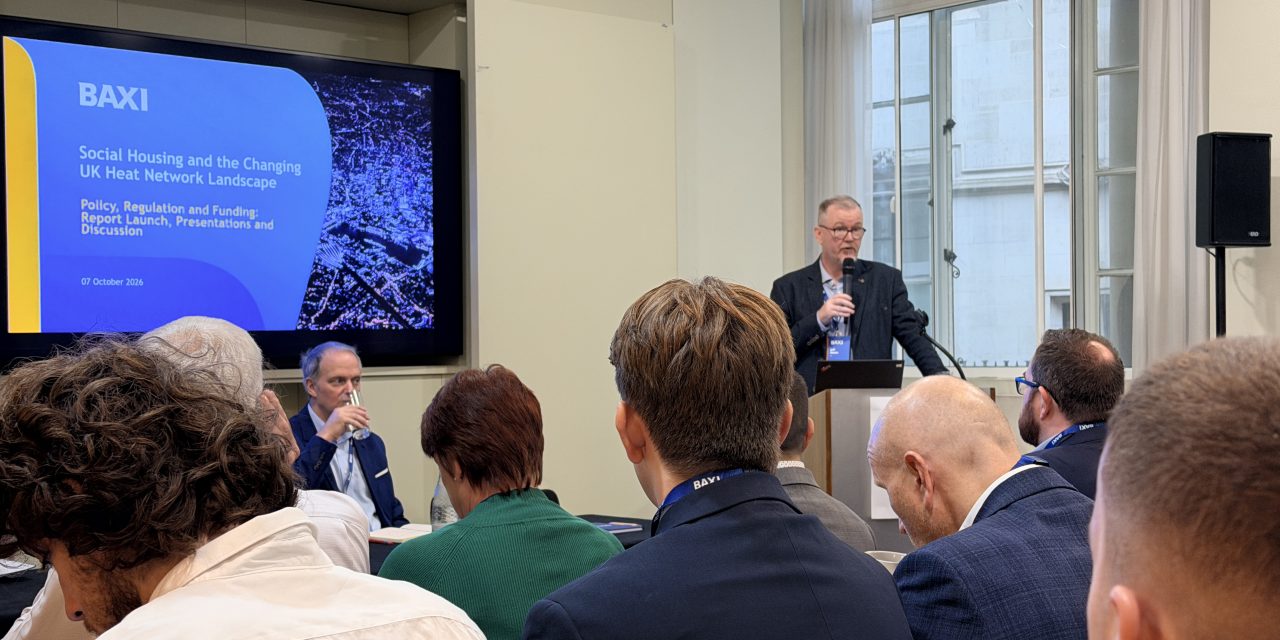
A heat network event hosted by Baxi on 7 October at Surveyors House at RICS in Westminster welcomed representatives from local and central government, social housing, policy and the supply chain to discuss the readiness for growth and regulation within the sector.
Heat networks are expected to fulfil 20% of all UK heat demand by 2050, currently providing ~3%. A new heat network regulatory framework is being introduced that will affect organisations involved in owning, operating, supplying through or receiving supply from heat networks. As social housing providers own and manage roughly two-thirds of all heat networks in the UK, the sector is a primary focus for the new rules.
Joining host Jeff House, external affairs and policy director at Baxi, on the Westminster panel were:
David Newton, head of heat network regulation at the Department for Energy Security and Net Zero (DESNZ)
Louise Singleton, principal consultant at Talan, (Heat Network Efficiency Scheme delivery partner)
Chris Unsworth, head of heat networks at the Association for Decentralised Energy (ADE)
Dan Perager, head of heat, energy and water at Notting Hill Genesis
The event was used to highlight the results of a recent Baxi research report. This summer, Baxi carried out a UK-wide survey of 100 housing associations and 102 local authorities managing or operating heat networks to understand how the sector is engaging with heat network policy, regulation and funding. Interviews were also carried out with five housing associations, one heat network consultant and one contractor in England and Wales to explore attitudes and understanding in greater depth. The subsequent report analyses the implications of the findings and includes Baxi’s policy recommendations.
Readiness of social landlords and local authorities
Respondents to Baxi’s survey generally reported a good understanding of heat networks and broadly positive experiences (80%), however the in-depth interviews highlighted that knowledge often sits with only a small number of specialists within each organisation.
Awareness and preparedness varied considerably across forthcoming requirements, particularly in relation to zoning (24%), technical standards outlined in the Heat Network Technical Assurance Scheme (38%), and metering and billing regulations (40%).
Most organisations were preparing or prepared for regulation, with confidence standing at 85% among housing associations and 67% among local authorities.
Funding knowledge was stronger: 42% understood the application process fully and 50% mostly, with awareness spanning the Green Heat Network Fund (GHNF), Heat Networks Delivery Unit (HNDU) and Heat Network Efficiency Scheme (HNES).
Organisations also want manufacturers to act as lifecycle partners, supporting design, technical input, funding applications, training, compliance, business cases, system performance and maintenance.
Regulation and consumer protection
The discussion highlighted that while heat networks should play a much greater role in the UK’s heating mix, organisations must be able to afford and deliver the required standards. The emerging framework is intended to bring heat networks closer to the regulatory model used for gas and electricity. While most customers may have a satisfactory experience of heat networks, the aim is to improve consumer experience for all by eliminating outages, overheating, high bills, noise, poor service and unclear charging.
A strong message was that all heat suppliers are already subject to relevant regulation, whether or not they have registered or fully recognise themselves as suppliers. Speakers acknowledged that some current approaches to debt collection and disconnection are unacceptable and must improve.
Heat Network Technical Assurance Scheme
The proposed technical standards were broadly supported, but speakers stressed that they must be proportionate, affordable and achievable. Importantly, it was noted that poor performance is not confined to old networks. Examples were cited of relatively new schemes suffering serious failures.
Concerns centred on:
the cost of compliance
insufficient metering and assurance capacity
skills shortages
the risk of unrealistic deadlines for existing networks
the ability of social landlords to recover or fund compliance costs.
The conclusion was that consultation responses were being considered before final proposals and a clear implementation roadmap are issued.
Heat network zoning
Zoning will identify areas where heat networks are likely to offer the lowest-cost, low-carbon heat. A national authority and local bodies in at least 10 major UK cities will oversee delivery. Ofgem’s consumer protection, standards and regulation are expected to take effect at the end of February 2027.
The first designated areas are expected to focus on major English cities, with further expansion later. Zoning was welcomed for creating opportunities and clearer roles and processes, although questions remain about the practical demands it will place on local and combined authorities.
There was also discussion about using zoning to deliver wider objectives such as fuel-poverty reduction, decarbonisation and coordinated local planning.
Funding the transition
Investment is essential to diagnose underperformance and deliver the improvements required by higher standards.
Two principal funding schemes were explained:
Heat Network Efficiency Scheme (HNES): supports existing networks through fully funded optimisation studies and part-funded capital improvements. Priorities include improving efficiency, reducing carbon emissions, lowering customer detriment and preparing networks for regulation.
Green Heat Network Fund: supports the commercialisation and construction of larger new low-carbon networks and the decarbonisation or expansion of existing schemes.
Participants welcomed both programmes but argued that substantially more funding may be needed, particularly to upgrade poorly performing social-housing networks. Match-funding requirements were identified as a barrier for financially constrained landlords.
Taking control at portfolio level
A recurring concern was the lack of reliable sector-wide data. The discussion highlighted that some landlords still lack a complete record of their heat networks, their condition, who they serve or where responsibility lies. Registration was seen as essential to provide consistent data which will make it easier to determine whether consumer outcomes have improved since earlier market studies.
Practical asset-management lessons
Notting Hill Genesis described a structured approach based on:
identifying every network and connection
clarifying ownership and responsibility
recording component condition and replacement needs
assessing efficiency and creating a network “health score”
prioritising investment using evidence
securing funding before commissioning detailed work
maintaining improvements through dedicated teams and performance dashboards.
A retrofit case study showed the potential benefits of better insulation, controls and system redesign, including lower communal temperatures, reduced gas consumption, improved efficiency and substantial savings.
Getting implementation right
The event showed strong support for expanding and improving heat networks, but also a clear warning: growth, regulation, consumer protection and technical improvement must be delivered together. Success will depend on proportionate standards, reliable data, adequate funding, stronger skills, clearer responsibilities and targeted support for social landlords — while ensuring that residents receive affordable, reliable and transparent heat services.
Reflecting on the event, Jeff House said: “This is a critical juncture for heat networks. While funding and support are in place, several challenges risk slowing the growth needed in the coming years, from labour shortages to limited awareness of the help available.
“It is imperative that clear, long-term roadmaps are put in place to upskill professionals, support the phased roll-out of HNTAS and, most importantly, protect consumers from unaffordable metering and billing costs. Events like these are invaluable in bringing together different perspectives, building a clearer picture of the direction of travel and identifying exactly how we can support stakeholders at every stage of the journey.”