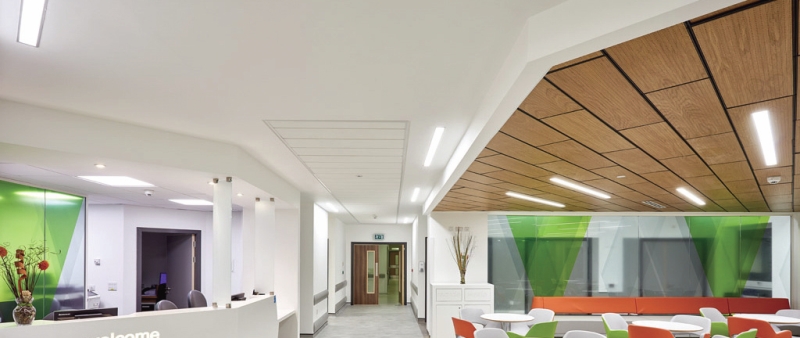
 CP Electronics reduced energy costs for the NHS during a refurbishment of Liverpool Heart and Chest Hospital’s outpatients’ unit. Intuitive, wireless lighting controls, coupled with the CP’s consultative approach, made the installation considerably easier, saving both time and money.
Amain challenge of the project was the outpatients’ department layout, which had three hallways intersecting to form a crossroads leading to the waiting room, with lighting in each of the hallways on individual circuits.
The consultant wanted to address this by running them on the same circuit, as this would allow them to be switched on and off simultaneously, whichever entrance was used.
Ordinarily, the contractor would need to re-wire the lighting back to the distribution board before installing the PIR-activated contactors used to operate the light fittings on and off. But on this occasion, this would have added additional complexity, cost and time to the project.
Following a discussion with Nick Booth, the CP Electronics Sales Manager involved in the project, wireless PIR presence detectors from CP were recommended to reduce the wiring needed.
Only power supplies for the wireless PIR presence detectors were required, resulting in significantly reduced installation time. Using wireless PIRs saved a minimum of 25% on total labour costs, making them a worthwhile investment.
For the end user, presence detectors help avoid unnecessary energy consumption by activating luminaires only when required.
Mark Middleton of project contractor, Copeland Group, said: “The wireless PIRs were unique to CP Electronics so there was a definite advantage to working with them, as opposed to any other lighting control manufacturer.”
DALI dimmer switches and Vitesse Modular are also being used in the reception to control the linear light fittings in the waiting area, which can be activated manually or configured to a specific pre-set scene. Users can activate the chosen scene without having to dim up and down. In either case, the plug and play design of the solutions specified proved decisive in ensuring a smoother installation, at a reduced cost.
Nick Booth, Sales Manager at CP Electronics, said: “We have a track record of working with contractors and consultants to enable cost and energy savings for the healthcare sector. In this instance, we took the time to understand the requirements of the project which put us in a strong position to recommend solutions which addressed the requirements of several stakeholders.”