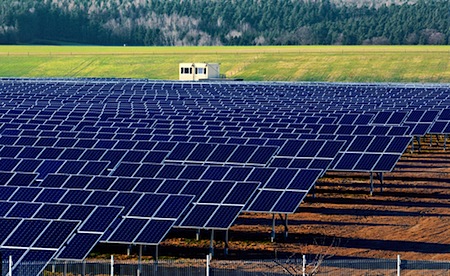
The UK is now extremely competitive in the ground-mount solar PV sector. CleanTechnica
According to industry website Wiki-Solar, the UK has leapfrogged Germany and jumped to third place in the world ranking for utility-scale solar photovoltaic (solar PV) power generation in the first quarter of 2015. By James Hunt:
The latest statistics from Wiki-Solar show that nearly 1.5 GW of installations were completed between January and the end of March this year. A table ranks countries based on their deployment of solar PV power plants of 10MWp and above. Over 300 MW was installed in March alone.
The UK, which now has 406 utility-scale projects having a total capacity of over 3.6 GW, has been beaten only by the US and China, and is now followed by Germany, India and Spain, according to the research.
The UK is now extremely competitive in the ground-mount solar PV sector, but the news that we are now globally third in the league table of utility sized solar PV power came just as the UK government closed the Renewables Obligation (RO) incentive scheme for ground-mounted solar projects of 5 MW capacity or larger to new generators.
More about the statistics
Wiki-Solar is the organisation that tracks and supports global utility-scale solar PV power plant deployment. The organisation’s large and comprehensive database of over 2,000 solar power generating stations worldwide, including both operating plant and projects in development, enables it to cumulate global and regional totals, and to assess average and best-case performance against a range of calculated key performance ratios.
These include the performance ratio (MWAC per MWp); the load factor (MWh per MWp) and typical households served; the site areas (hectares per MW); the carbon emissions savings (tonnes / MW) and typical equivalent vehicles; plus the average project values and financing ratios.
Some of these ratios can be compared with theoretical or published global and national data on parameters, such as solar array density, household electricity usage and the carbon intensity of the grid.
Furthermore, Wiki-Solar can do this by continent and sub-continent, by country and by province, state or county. All deployment tables show the cumulative capacity of utility scale projects in MWp, along with the number of individual plants or projects. For more information, go to: www.wiki-solar.org
Meeting all Scotland’s power needs
There is more solar news – this time concerning domestic supplies, as Energy Live News reports.
On Election Day, when Scottish politics is likely to have a big influence on the Westminster Government (whichever party it is), comes the revelation that there was sufficient sunshine in Scotland last month to meet all of its electricity supply needs.
More than 35,000 Scottish homes and 600 businesses currently have solar PV arrays fitted, and the new statistics from an analysis by WeatherEnergy showed that April’s sunshine in Edinburgh alone generated more electricity than used in an average home – 113% more. For Aberdeen it was 111%, for Inverness 104% and for Glasgow it was 106%.
For houses having solar thermal (hot water) panels – rather than solar PV – there was sufficient sunshine in Edinburgh, Glasgow and Inverness to generate 100% of an average household’s hot water needs and 99% for those homes in Aberdeen.
All of this should also be good news for Scottish and wider UK electrical contractors and installers because of the real and potential business benefits that result.
Take advantage
More homes and businesses should take advantage of solar technologies, thinks WWF. Commented WWF Scotland’s Director Lang Banks: “For the tens of thousands of Scottish households that have already installed solar panels, there was enough sun to effectively meet all of their electricity or hot water needs, helping to reduce our reliance on polluting fossil fuels.
“With these sorts of figures, every home or business with a south-facing roof should seriously consider switching on to the full potential of solar power. Similarly, there is no reason why Scotland should not be home to commercial-scale solar farms,” he said.
That isn’t all, because Scotland’s installed wind turbines generated enough additional electricity to supply the needs of 69% of householders – equivalent to 1.7 million homes.
Check out www.weatherenergy.co.uk to see the WeatherEnergy map.