 B.E.G. has launched a new rectangular flat PIR sensor which is virtually “invisible” for ceilings or luminaires, combining the advantages of passive infrared sensor technology with intelligent design.
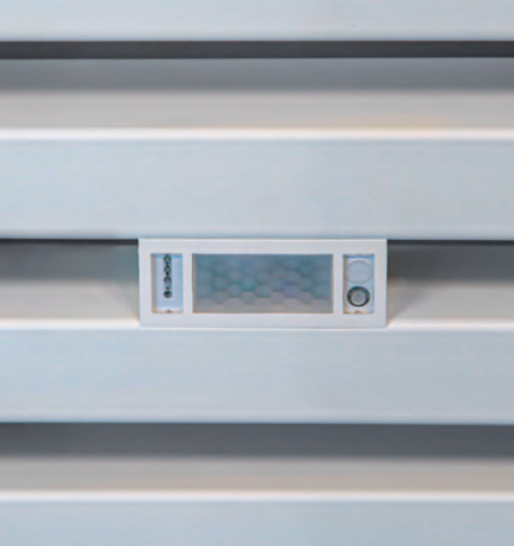
Integrated into slat ceilings or luminaires, the sensor is designed to be unobtrusive and can blend into virtually any room space. The PD5N becomes the latest DALI-2 certified device to be launched by B.E.G, ensuring a high level of interoperability so it can be used wherever light and motion detection need to be measured.
Paul Jones, sales director of UK and Ireland at B.E.G., said: “In business premises, offices, conference rooms or classrooms where detection ranges of less than 10m are required, working, and living comfort requirements determine the design. In such cases, it is nice when technology blends into the room design as unobtrusively as possible, and this is exactly what the new B.E.G. PD5N PIR sensor delivers end users.”
The PD5N PIR sensor has a nine-metre detection range and is developed for lamella ceilings or vaulted roofs which typically consist of a criss crossing pattern of parallel arches skewed to the sides of the covered space. Lamella ceilings tend to be composed of relatively short members hinged together to form an interlocking network in a diamond pattern, such as designed by Interalu with their SAPP ceilings.
The unit is pre-wired so it can be plugged in directly and clicked into place. For dark slat ceilings, a sensor with a black housing is available in addition to a white one. The sensor is also suitable for installation in DALI-2 luminaires and in a luminaire strip.
The B.E.G. PD5N detector is characterised by low power consumption of the devices providing a positive effect on the load of the DALI BUS. The five new instances can be conveniently operated by end users via a B.E.G. mini-IR remote control. Other features include setting options for the resolution of the light sensor from 12 bits to 10 bits which is designed to achieve greater results of light control in unfavourable room conditions – made via the generically accessible memory bank.
The reflection factor can also be set to values between 0.1 and 1.0. This simplifies the use of higher-level visualisations, as the lux value transmitted by the sensor no longer needs to be converted.